Main

December 11, 2008

Putziness!

I am passionate about the Mets. I am passionate about the Broncos.

So imagine my pleasure when, within a single 12 hour span, my two favorite teams acquired a pair of players named Putz (J.J.) and Putzier (Jeb)!

J.J. Putz    Jeb Putzier

Now if only the Nets can find some little-known basketball talent named Putziest!

May 29, 2008

My aspirations

I really want to write a movie that stars Jose Reyes and Carlos Delgado...

...as a crime-fighting duo, of course.

March 12, 2008

Classless Yankees

The New England Patriots of Major League Baseball, if you ask me. Read more.

March 11, 2008

Too Good Not To Blog

From "Clinic wants to be 'snip city' at NCAA tourney time":

For guys who park in front of the TV during college basketball's March Madness, the Oregon Urology Institute has a suggestion: Why not use that time to recover from a vasectomy?

Why not, indeed?

February 13, 2008

Appropriate Bedfellows

The republicans, acting as a squadron of defense attorneys for Rogers Clemens, and Clemens himself, with no explanations about any of his contradictory testimony or about Andy Pettitte's testimony. I must say I was a tad disappointed that none of the congresspeople asked Clemens if he was on steroids when he hurled a broken bat at Mike Piazza.

February 6, 2008

Strange Bedfellows?

The three best catches in New York sports history? Any other suggestions?

October 1, 2007

Tom Glavine: Winless with a 9.50 ERA

We're all astute at judging performances. We judge the depth of feeling and believability with which an actor delivers his lines. We judge the songwriting, voice, and musical performance of rock stars when we attend their concerts. And of course, we judge the power, speed, and wit with which a professional athlete plays his sport. And that's all fine.

But we don't only judge performances; we also judge people. We judge public figures by all kinds of metrics. Most of them are not fair. It's not fair that I disliked former Mets Brian McRae and Jose Vizcaino because of a perception that they didn't play baseball very well. And it's not fair for me to dislike Kenny Rogers because he walked in the winning run for the Braves in the 1999 National League Championship Series. It's even not fair for me to dislike Derek Jeter because he always gets the clutch hit, is tremendously overrated by fans and media alike, and walks around with a stupid grin on his face. I admit it: it's not fair and I probably shouldn't do it quite so much.

There are, however, some legitimate reasons to dislike public figures themselves, rather than just dislike their performances. Many people dislike John Rocker for the homophobic and hateful comments that he spewed forth several years ago. And many people dislike Brett Myers for abusing his wife. And many people dislike Barry Bonds for cheating his way to a lifetime home run record. These are all character flaws, demonstrations of a lack of respect for other people in the world. And that is, in my opinion, a reasonable cause for disliking a person.

I disliked Tom Glavine when he came to the Mets. After all, he was a Brave, and he'd been beating the Mets for years and years, and such poor reasons for disliking a person do not disappear over night. I spit vitriol at him after his first season at the Mets, when it seemed that time and time again he rolled over and mailed in a poor pitching performance against the Mets biggest rivals--especially against the Braves. But I was wrong to dislike him for that: Dislike his performances, sure; but dislike Tom Glavine the person? Shouldn't have done it.

And then he got better. He was never a truly dependable #1 starter for the Mets, but he had his fair share of brilliantly pitched games. And I was a hypocrite: I smiled and I cheered and I called this person who I had disliked, "Tommy." I think I even gave him a standing ovation in the comfort of my living room when he earned his 300th career win. I began to relish the thought of Glavine executing his 2008 player option to stay with the Mets next year. But as I watched his stoic approach on the mound; as I saw his picture-perfect family interviewed time and time again on ESPN; as I listened to the accolades heaped on him by fans, media, and current and former teammates: Underneath all of it I held onto a vague feeling of distrust.

Over the past month, this distrust was repaid in spades. An article on the Mets historically stunning collapse notes that Tom Glavine, the Mets #1 pitcher, was "winless with a 9.50 ERA over his last four starts of the season." Of course, this was topped off by yesterday's implosion when, faced with the opportunity to pitch in the most crucial game of the season, Glavine managed to record only a single out while giving up seven runs in the first inning and punctuated his outing with a throwing error and by hitting the opposing hurler with a pitch.

But this is simply poor execution by a baseball player, and it's not just cause for disliking Tom Glavine, as much as I might want to. And yet, I dislike Tom Glavine. Strike that. I <i>despise</i> Tom Glavine. And it's not because he's a mediocre pitcher who feeds on batters' weaknesses and the tendency of umpires to give him a generous strike zone. It's because he has no respect for other people.

After the game, Glavine commented on his performance:

I’m not devastated. I’m disappointed, but devastation is for much greater things in life. I’m disappointed, obviously, in the way I wanted to pitch. I can’t say there is much more I would have done differently.

Glavine wouldn't have done anything differently? And he's simply disappointed? Sure, I agree that there are more important things in life. But it is inexcusable for Glavine to not acknowledge his role on a team, his responsibility to the other Mets he's worked with for so long, and--perhaps most of all--the hopes and dreams of the millions of fans who not only cheer the team all season long but help pay their salaries. I'm not the only guy who pours his heart and soul into every pitch of every Mets game of a given season. And while there are lots of reasons the 2007 season ended in abject failure, Glavine seems to be the only one[1] not respecting the effect of his contribution to that failure on the people around him. That's a lack of respect. It's a smugness that takes for granted his teammates and fans, and I find it disgusting. And so I despise Tom Glavine.

Tom Glavine is not a horrible person. He gives back to his communities, and he treats his family well. He probably even thinks that he does a service to people everywhere when he puts baseball in context, compared to the "greater things in life." But in doing so, he's spitting on everyone that counts on him in a big moment to rise to the challenge. One day in the not-too-distant future, Glavine will be inducted into the Baseball Hall of Fame in Cooperstown. And when they unveil the plaque that will forever immortalize his performance on the field, I can think of nothing better for it to read than "Winless with a 9.50 ERA."


[1] I haven't seen much remorse towards the fans from Willie Randolph either. But Willie clearly is devastated on behalf of his players, which is a start at least. Whether or not he takes his fair share of the blame is a conversation for another blog post.

August 30, 2007

Grading the Voices of the Game

I've been meaning to blog about this for, oh, about forever. But finally Ben took the lead and shared his thoughts on what we're looking for when listening to radio and TV baseball broadcasters. Ben talks about some of the worst of the worst and contrasts them with some decent out-of-town announcers.

What I'd like to do is define some criteria for evaluating broadcasters--both play-by-play men and color commentators. Once we have such a rubric, it will be pretty easy to fill in the details while watching/listening to a game, and eventually build up a portfolio of evaluations for broadcasters around the league. This, in turn, will allow me to pick and choose when to listen to out-of-town broadcasters (either because they're excellent or because I feel the need to raise my ire) and when to avoid them.

So, here's a first stab at criteria. Please share your own in comments or on your own blogs:

  • Homerism. By far the biggest flaw of amateur broadcasters, homerism refers to the practice of openly rooting for the team whose games you announce. There are several degrees of homerism, some more egregious than others:
    • "We." Use of first person plural to describe the team for which a sportscaster broadcasts (sportscasts?). Example: "Gonzalez hits a two-run home run, and we pull within three of the Tigers."
    • Player familiarity. Use of first names and nicknames for the broadcaster's team, but not for the opponent. Example: "J-Ro" for Jimmy Rollins. "The Giambino" for Jason Giambi.
    • Cheerleading. Exclamations of joy (when something good happens) or disgust (when something bad happens) oriented only towards the broadcaster's team. Example: "He gone!" (see Ben's post), "oh no!"
    • Umpire bias. One-sided criticism of umpires' calls in favor of the broadcaster's team. Example: "Ortiz goes down looking at that curveball, which was clearly outside," without an accompanying "And Wakefield gets lucky on a called third strike that really should have been ball four."
    • Uneven excitement. Broadcasters should temper their excitement at plays on the field based on their significance to the game, rather than their benefit to the broadcaster's team. (Ben has an example of this in his post.)
  • Knowledge of the game. This might actually be a sub-category of homerism, but I'll list it on its own for now as a more general phenomenon. Some announcers, while quite familiar with their home team, know very little about the opponent's team. They don't know trends, abilities, and history beyond what the game notes tell them, and this makes their in-game analysis awfully one-sided. Others just don't seem to bring much insight to a baseball game at all: they fail to discuss things like hitting the ball to the right side to advance runners on the base paths or the merits of defensive shifts and positioning or strategic use of a team's bullpen and bench.
  • Accurate depiction of the game. Some play-by-play announcers don't tell the listener what's happening in the game in a timely fashion. Others consistently get it partially or entirely wrong. (Example: "It's a deep fly ball to left field, way back, way back... and it's caught six feet short of the warning track.") For color commentators, this is reflected in mispronouncing players' names and often getting the names wrong altogether. (Hello, Joe Morgan, I'm looking at you.)

Hmm, so it actually looks like most of the criteria do fall pretty broadly under homerism, despite my initial attempts at breaking that out as its own category. There are some other intangibles which make for great announcers, such as the ability to paint a beautifully flowing word picture, a melodic voice and cadence, and a love for the game, but those are a bit harder to evaluate.

What else do you suggest goes into a great or horrible baseball broadcaster?

(Thanks, Ben, for getting me off my ass to write this.)

August 22, 2007

The 2007 Mets: The Steve Bartman Reunion Tour?

I'm sure we all remember the Steve Bartman incident from the 2003 NLCS. Bartman was a Cubs fan that knocked a foul popup away from the pursuing Cubs outfielder, allowing the Marlins to prolong a rally and eventually win the game and the series.

What most people don't remember--I didn't, at least--was who the other key participants in that infamous play were. The batter of the lazy foul ball was the Marlins second baseman, Luis Castillo. The left fielder chasing the ball was Moises Alou. And, of course, with the trade-deadline acquisition of Castillo, both are now key members of the 2007 Mets.


(Thanks to the Wikipedia entry for Luis Castillo for reminding me which players were involved in Bartman-gate. I doubt I'm the first to make this observation about the 2007 Mets, but I haven't seen it anywhere before.)

July 23, 2007

Litmus Tests #28

There are a few things in life which I'd be comfortable using as a litmus test to judge the competency of people to participate in the important aspects of society--things like voting or teaching our children. In the light of the recent NBA scandal, I wanted to note that (despite this story!) one of my litmus tests is:

Have you ever called a sports-talk radio station to espouse a theory that a sporting contest was fixed by gambling coaches, athletes, or officials?

May 27, 2007

Jane Heller of the New York Times is the Lamest Sports Fan Ever

...and you know me: I'd love to use this as an occasion to make fun of the Yankees, but it's really not. It's just an occasion to point out that, holy cow, Jane Heller of the New York Times is the lamest sports fan ever.

I gave it everything I have. I am sick and tired of the “I trieds” and the “What do you expect me to dos?” I’ve been begging for answers and all I have gotten are platitudes. Enough is enough.

And so I am divorcing the New York Yankees — all 25 men on the active roster, in addition to the manager, the coaches and the general manager. Oh, and the trainer, too. And, of course, the owner and all his baseball people.

Read the whole thing.

May 14, 2007

On Giuliani, the Yankees, and Corruption

This entire article (yes, Dodzie, all six pages), is well worth reading.

The Yankees' Clean-up Man:

The greatest love affair of Rudy Giuliani's life has become a sordid scandal.

His monogamous embrace of the Yankees as mayor was so fervent that when he tried to deliver a West Side stadium to them early in his administration, or approved a last-minute $400 million subsidy for their new Bronx stadium, New Yorkers blithely ascribed the bad deals to a heaving heart.

It turns out he also had an outstretched hand.

April 17, 2007

Phillies' Broadcasters

This probably comes as a surprise to anyone who knows me even a bit, but I really like the Phillies' TV broadcasters. Especially their main play-by-play guy, Harry Kalas.

...

But if I have to listen to him refer to Jimmy Rollins as J-Ro one more time, I think I might vomit.

March 27, 2007

QotD: On Opening Day

Ben Szekely, on the excitement surrounding baseball's upcoming opening day:

It's like having a great TV show to look forward to every day. And it's three hours long.

Well said, Ben, well said.

January 14, 2007

LT tells it how it is

First Belichick is caught manhandling a cameraman out of the way while rushing to gloat about his victory over Eric Mangini. Now this.

I hate the New England Patriots

There's no two ways about it. I don't know how they can go on time and time again winning playoff games without deserving them. It's disgusting.

Football's full of mistakes. They're a part of the game. But certain mistakes are so fundamental that professionals avoid them--in general. It's these mistakes that teams facing the Patriots in the playoffs regularly make. Today's loss by the Chargers was a perfect example. The mistakes include dropping wide open passes, inexplicable play calling, boneheaded penalties, ridiculous challenges, and, of course, intercepting a fourth-down pass instead of knocking it down. Don't get me wrong: the Chargers did not deserve to win this game either. But the thing is, in a fair world, the Patriots would lose just as many games that neither team deserves to win as they win. But that's not the case; rather, the Patriots win almost every single game when both teams play like crap, and that disgusts me. (Ok, well, that combined with Patriots fans interpreting their victories as being due to the supreme excellence of their football team, rather than the other teams' gift-wrapping the games for them.)

The Chargers should have won this game by 20 points. Instead, they handed the game to the Patriots on a silver platter, and the Patriots, who had looked inept and overmatched for much of the game, performed admirably in the clutch and accepted the victory. Belichik didn't win this game; Brady didn't win this game; Gostkowski didn't win this game. The Chargers lost this game, as so many Patriots opponents have done in the playoffs over the past six years. Some day the karma must run out, and I hope I'm around to enjoy it.

Fuck the Patriots.

Go Colts.

January 2, 2007

Seasons Cut Short

There's a thing about being a passionate sports fan: you're almost always disappointed. Even fans of perennial cellar-dwellers (e.g. Lions) and teams which face long odds even before the season's first game has begun (e.g. Devil Rays) are disappointed in the end, despite realistically low expectations. And for those of us fortunate enough to root for large market and consistently competitive teams, the brutal reality of a season's hopes dashed is a pain that can endure throughout an offseason.

Of course, the particular nature of the end of the season goes a long way towards determining the degree of devastation. When the Mets fell to the Cardinals in Game 7 of the NLCS this year, the shock was sudden and severe. That game featured perhaps the greatest catch in baseball postseason history, which brings me to this year's Denver Broncos season. You see, football has its own version of the catch, and 24 years after Joe Montana and Dwight Clark hooked up on that famous play, the 49ers--now a much more diminished and desolate franchise--ended the Broncos playoff hopes and their season with a 26-23 overtime victory. One week after the Broncos squeaked by a far better Bengals team on a botched extra point, the Broncos failed to will their way into the playoffs and saw a promising season that started 7-2 end in disappointment.

But 2006's seasons will be marked as much by the abrupt season ends of a few players as by these nailbitingly disappointing final games. Both the Mets and the Broncos saw their share of normal injuries: knee injuries, torn rotator cuffs, strained rib cages. But it's the unusual circumstances that cut short the season's contributions of a few key players which stand out.

For the Mets, this means Duaner Sanchez, who separated his shoulder and was out for the closing half of the season and playoffs after being a passenger in a taxicab accident in Miami. It could also extend to Orlando 'El Duque' Hernandez, the Mets secret weapon for the playoffs, who injured his calf days before the NLDS while doing nothing more spectacular than jogging in the outfield.

This year, the Harvard Crimson basketball team has their own case of a season cut short. Brian Cusworth, their senior center, is graduating this winter and will be ineligible to play basketball after January. He'll play Harvard's first two league games, and then the team will be without their court leader for the rest of conference play.

But all of this is really just a prelude for a mention of the ultimate in seasons cut short. Mere hours after the Broncos fell to the 49ers, 24-year-old Bronco starting cornerback Darrent Williams was murdered. He sat comfortably with teammates and friends inside his limousine, and for reasons unbeknownst to us a drive-by shooter sprayed a dozen bullets into the vehicle, one of which caught Darrent's neck. We learn from the media in his death of Darrent's energy and passion for life, and we learn of the youth programs he's worked to establish to keep kids in his Texas hometown away from violence and out of trouble. Darrent had a rough childhood but had succeeded despite long odds; he was already poised for a tremendous NFL career and a lifetime of helping others avoid the hardships he once faced.

And now all that potential has been taken away in one senseless killing. If that's not a season cut short, I don't know what is.

Darrent Williams, 1982-2007

December 6, 2006

The Red Soxees?

A couple of years ago, the Red Sox offered Pedro a three-year contract and refused to go to four years citing injury concerns and an overall feeling that the contract was too long for the risk to match the value. Last year, the Red Sox let the Yankees sign Johnny Damon, again citing their belief that Damon's value did not match the money they'd need to offer to match the Yankees contract.

This offseason, it seems that all considerations of value have flown out the window. Julio Lugo for $8 million ($9 million? I've seen conflicting reports) per year at shortstop. He's an upgrade over Alex Gonzalez, but probably not for the value difference. The oft-injured JD Drew for $15 million per year for four years? Again, not a value signing. And $50+ million just to talk to an unproven Japanese pitcher? That smacks of competition rather than value.

All this is to say that when Mets fans or Red Sox fans or Dodgers fans or whoever talks to Yankees fans and chides their team for their runaway-train spending trends, the Yankees fans invariably respond with something along the lines of "Well, your team spends over $100 million and could spend as much as the Yankees." The difference here is that the other teams pay attention to value when making trades and signing players. They do have the money to spend, but they choose to spend it in a pennywise fashion (at least, as best as they can judge) rather than throwing arbitrary sums of money at the best players on the market. The Red Sox, it seems, are beginning to eschew value signings in favor of target signings: target a player and then sign them, regardless of the relative value of the contract's finances.

I fear that this is a watershed change for the Red Sox, and that it is only a small step away from the most insidious of the Yankees' practices. The dominance of the Yankees' spending habits doesn't lie so much in being able to sign players between seasons. Instead, their real power is that their reckless spending and huge payroll allows them to give up on failing-but-expensive players without a second thought (usually during a season) and pursue expensive replacements. Two years ago, the Mets stuck with Kaz Matsui despite his poor performance. They had invested in him, and to bench him at that point would decrease his effective value to zero. While that would have been a good baseball decision, the Mets were (and are) playing within a budget—and within this budget decisions needs to be made based on financial value. The Yankees are at a point where they can and do ignore financial value, and this allows them to abandon failed projects at a whim and pursue new opportunities. The Red Sox seem to be moving in this direction, and I think that that's a bad thing for competition in baseball.

Just some rambling thoughts during this week of MLB winter meetings...

November 9, 2006

Scarlet Knights!

Way to go, Rutgers!

This week just keeps getting better and better and better.

October 18, 2006

Game 6, 20 Years Later

I was just about the only person I knew preaching the belief that yesterday's rain out hurt the Mets far more than it helped them. After tonight, I'm sure there will be many experts preaching the same thing.

But to hell with the analysis. To hell with the punditry. And to hell with the matchups, the injuries, the umpiring, the managing, the bullpens, the starters, the hitters, the men left on base, the fielding, the baserunning, and the bunting. To hell with it all, because in the end the game is played between the foul lines, and tomorrow is (logically speaking, at least) twenty years after Game 6.

Twenty years later, I still believe. Let's go Mets.

October 7, 2006

An Update

The baseball playoffs roll on, but now only one thing really maters:

  1. I want the Yankees to lose as soon and as brutally as possible.
  2. Let's Go Mets!

You gotta believe.

October 3, 2006

We're All Grown-ups Here

We're all grown-ups here, and so I'm going to save my breath.

I don't need to expound on the virtues of October baseball.

I don't need to talk about the thrill of being back after five years away.

I don't need to write about expectations, starting pitching, lineups, or bullpens.

I don't even need to mention the exorcising of memories of 1988.

It's time for the baseball playoffs, and only two things really matter.

  1. I want the Yankees to lose as soon and as brutally as possible.
  2. Let's Go Mets!

You gotta believe.

September 25, 2006

Blog Entry Reuse

One of the first things you learn as a young software developer is to avoid writing the same code twice. If you—or someone else—have already written certain code, then don't rewrite it, just reuse it. With that in mind, I'll defer to myself.

September 18, 2006

x-N.Y. Mets

I do so love that little 'x'. Let's go Mets!

September 15, 2006

Our Boston Sports Heroes

I'm surprised at the type of attention that David Ortiz's comments earlier this week have gotten. Almost all media reports have focused on how his commentts slight Derek Jeter. While I was surprised that he would be willing to openly speak about Jeter, I found far more than just the anti-Jeter comments objecitonable in Ortiz's statement. (OK, in fact I didn't find the anti-Jeter parts objectionable at all. Jeter's an overrated piece of garbage.). Let's look at the comments:

They're talking about Jeter a lot, right? [1] He's done a great job, he's having a great season, but Jeter is not a 40-homer hitter or an RBI guy. It doesn't matter how much you've done for your ballclub, the bottom line is, the guy who hits 40 home runs and knocks in 100, that's the guy you know helped your team win games. [2] Don't get me wrong -- he's a great player, having a great season, but he's got a lot of guys in that lineup. Top to bottom, you've got a guy who can hurt you. Come hit in this lineup, see how good you can be.[3]

I've picked out three points in there to which I object:

  1. From the accounts I've read, Ortiz was being asked about the MVP race in the AL. Isn't it a cardinal rule of good-guy athletes not to talk about individual statistics, streaks, or especially year-end awards during the season? To me, doing otherwise demonstrates somewhat of a me-first attitude.
  2. Ortiz asserts that 40 HRs and 100 RBI is more important to winning games than anything else. Apparently Ortiz doesn't value fielding at all. Nor does he value base running, on-base percentage, hitting for average or any other ways in which a player can contribute to his team.
  3. To me, this was the most galling of all the comments. Here, Ortiz goes out of his way to insult the rest of his teammates on the Red Sox lineup. Sure, the Red Sox have been hit hard by injuries in the past month, but that doesn't mean that the slugger needs to go throw his (current) teammates under the bus like this. Way to go, Big Papi.

I was just as surprised to read what Boston's football hero had to say early this week. Tom Brady:

Last week I spent a lot of energy thinking about [the Deion Branch situation] but at the end of the week, it really wasted a lot of my time. It was a big mental drain and I think it affected the way I played. I don't feel like I brought as much to the table as I normally could.

Surely you jest, Mr. Brady. You were so worried about your teammate's hold out—a hold out which was not at all new news in the week leading up to the game—that it affected your performance on the field? Two possibilities here:

  1. Brady's telling the truth. In this case, I find it inexplicable that Brady would be so unprofessional as to put fifty teammates' success on the field at risk by not taking proper care of himself (mentally) in the days leading up to a game. That's weak, Tom, real weak.
  2. Brady's not telling the truth. In this case, this is one of the worst excuses I've ever heard for a mediocre performance by an athlete. Suck it up, Tom, and play better against the mighty Jets this Sunday.

Needless to say, I love this stuff.

September 11, 2006

The hobgoblin of my little mind

I've maintained it all year, and I don't see any reason to back off now: I think that the Detroit Tigers are overrated and, furthermore, I think that the Detroit Tigers will not make the playoffs. Just for the record, y'know.

September 10, 2006

The NL East's Magic Number is 2

The current standings in the National League East look like this:

Team		Wins	Losses	Games Back
-------------------------------------------
Mets		88	53	--
Phillies	72	70	16.5
Marlins		71	71	17.5
Braves		68	73	20
Expos		61	81	27.5

These standings would lead many people to believe that the magic number in the East is 5 (162 + 1 - 88 - 70 = 5). After all, any combination of 5 Mets wins and Phillies losses clinches the division for the Mets.

However, for many of us Mets fans, the real celebration has a magic number of 2. Any combination of 2 Mets wins and Braves losses will bring to an end the run of 11 straight years in which Atlanta has won the division. The clouds will part; the yoke will be lifted; a new era will begin.

Yes, for the Mets the season has barely begun at this point. There are many tests awaiting the Mets in the playoffs, and everything until then pales in comparison. But nevertheless, the events preceding October baseball should not be overlooked. We'll celebrate the division clinch, sure. But I, at least, will celebrate even more the fruition of these words which have adorned the signature of a regular poster in the Mets Usenet group for many years: Atlanta delenda est.

With a magic number of two, this monumental day could come as soon as tomorrow, so keep your eyes peeled.

August 11, 2006

Bad Baseball Broadcasters

Way #581 to tell that you're a bad hometown baseball broadcaster:

When the pitcher on the team you broadcast for throws a strike as the first pitch in the inning, you say:

'Atta boy!

Here's to you, Mr. Washington-Expos-color-commentator.

July 24, 2006

They win; they finally win!

This past weekend, Lynn and I went down to Jersey to spend some quality time with our families. After Lynn exerted her will through a five-hour drive filled with flash storms and miles of traffic, we met up with Lynn's Grandpa Sam, Uncle Mike, and Mom and Dad in Tarrytown. We ate Portuguese and Brazilian food at Caravela in downtown Tarrytown. (I enjoyed a decent braised veal dish served with some mashed potatoes that I suspect were not authentic but which I enjoyed very much nonetheless.)

On Saturday, the six of us who went to dinner on Friday were joined by my Mom and by Wing (who had been rendered plans-less by the immovable force of a girls' (and Jeff?) spa day) at Shea Stadium to see the Mets host the Astros. Now, if you've even read just a few weeks back in my blog, you'll know that Lynn and I have not had the best of luck recently when it comes to attending Mets games in person. And with the mysterious El Duque on the mound for the Mets against the freshly-back-from-the-DL Brandon Backe, I didn't know what to expect.

As we drove into Queens a bit after noon, it became clear that the one thing that I had not expected would be the one thing I was going to be guaranteed to get: rain. Lots of rain.

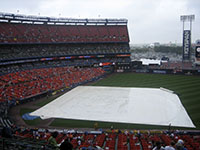
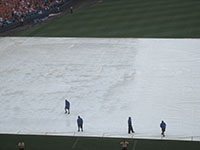
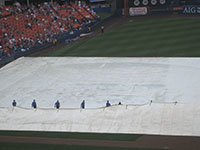
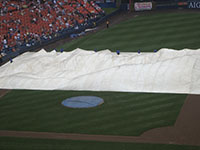
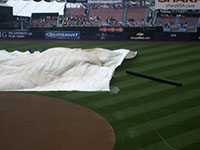
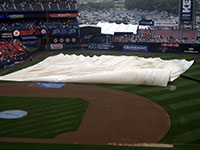
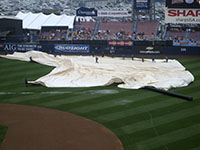
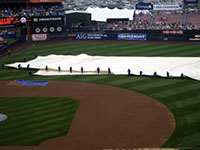
We met up with Wing and headed to our seats—but say several rows higher up so that we could be covered while we watched the tarp do its best imitation of a corpse until just about twenty minutes past scheduled game time. It was then that rain subsided, the crowd let out a roar, and we were treated to the dance of the grounds crew as they uncovered the field and prepared for the game.

rain delay at Shea    rain delay at Shea

Once the game got underway, our misery intensified as the Astros shelled El Duque in the first inning to the tune of three runs on two home runs. But after that, something miraculous happened: El Duque settled down, and the Mets bats came alive just enough to take a one-run lead on Xavier Nady's three-run shot in the fourth inning. And even though Wing committed baseball sacrilege by leaving before the game was over (OK, he had a good excuse and had warned me beforehand, for the record), Duaner Sanchez and Billy Wagner managed to protect the lead and give the Mets the win. Oh rapture, oh joyous day.

We spent the rest of the afternoon and evening with the Marshalls, where I got a good fix of Julia time. (Julia time mostly consists of playing with a beach ball, staring at a Mets pin with glowing lights, counting to five (sometimes to ten, sometimes in Spanish) over-and-over again, and running around on the floor aimlessly. As I said on the drive back today, I wish more of my friends played the way Julia does.) We ate dinner at an Italian restaurant in Queens which apparently serves delicious pasta—I wouldn't know because I tried the porcini risotto which was mediocre at best. I should have known better when the menu spelled it "porchini."

Sunday arrived and treated me to an emotional back nine at the British Open, culminating in victory and runner-up for the two (prominent) golfers who have lost parents in recent weeks. I think it's amazing and not inaccurate to say that I can empathize with Tiger Woods about something. As he said in his victory speech following the tournament, we all have parents and for almost all of us, they mean the world to us and we miss them terribly when they're not here.

In the afternoon we visited Grandpa and Millie along with Millie's daughter Audrey and granddaughter Sarah. After a couple of hours Lynn and I said are goodbyes and got on the road back to Boston. Lynn slept most of the way and I hummed to myself and noodled on ways to implement abstract syntax tree rewriting schemes in the SPARQL engine I'm working on at work. Clearly, fun times were had by all.


You can see more pictuers from the weekend, including some pictures of Julia, a puddle, and a reservoir, in my photo album.

July 10, 2006

He's talking to *you*, Mr. Torres

I started reading a blog known as Waiter Rant recently. Today part of one of the posts sounded very familiar to me:

“Our sous chef’s full of crap,” I groan. “He only gets interested in soccer during the World Cup.”

“Well,” Celine huffs, “You get all baseball crazy during the World Series.”

“That’s different.”

“It’s the same thing.”

“No it’s not.”

“Now you’re the one who’s full of shit.”

“Maybe,” I reply, returning to my paper.

Sound like anyone you know? ☺

June 28, 2006

Mets v. Red Sox, Game 2

What's to say, really?

I can't remember the last time that I've been to a Mets game in person and seen the Mets win. It's been six or seven in a row now. And in most of them, the Mets haven't even shown up to play.

You know there will be callers who will call WFAN and suggest that Pedro grooved pitches tonight for his old teammates. It's absurd, but it'll happen, and it might even catch on enough to be a "story" for a day or two. What happened in reality is that the red hot Sox lineup demolished a Mets starter who didn't have his stuff today.

Tomorrow's the most challenging matchup of the series for the Mets, so I'm pretty much expecting to see the Mets lose, again. It does kind of suck when you spend so much time looking forward to a particular series of events in your life and then they pretty much blow goats. Oh well.

At least Lynn's hand is doing better today; she might go get X-rays but it's not hurting today nearly as much as we expected.

Mets v. Red Sox, Game 1

Tonight was the first game of the Mets–Red Sox interleague series. The Sox won 8 - 4, but that's the least of what there is to say about the game. Here's the capsule "highlights":

  • The game. Alay Soler had poor control and was pounded. Even many of the outs he recorded were hit very hard. On the other hand, Jon Lester was barely hit hard at all. He was wild though, which would worry me a bit if I were a Sox fan, but overall he seemed in control. Reyes was banged up when he was thrown out at home plate by Manny, but he stayed in the game. Nady was taken out after being hit in the wrist by a pitch. We (Lynn and I) knew the game wasn't going our way when Lastings completely misplayed a flyball near the Green Monster. Actually, I thought all three Mets outfielders looked shaky on flyballs for most of the early innings. Not sure why.
  • The ceremonies. Unbeknownst to me prior to today, the Sox staged a commemoration of the 1986 ALCS Champion Red Sox team today. While Bill Buckner couldn't attend (he's apparently in Washington state visiting a college with one of his children, but the Red Sox want him to know he's welcome back any time), luminaries such as Bruce Hurst, Dwight Evans, Jim Rice, and Wade Boggs (booooo Yankee!) were in attendance. Was quite enjoyable to have no qualms about celebrating that 1986 team along with all the Sox fans.
  • In enemy territory. For the most part, our interactions with Red Sox fans were friendly and good-natured. Two twenty-something Red Sox fans pointed out the guy on stilts following me around outside the stadium while holding up an "I love the Red Sox" sign (Lynn had already pointed it out), and we ended up agreeing that we all despised the Yankees. The fans around us cheered for the Sox without showing any abuse to us or the few Mets fans that were seated near us. One Sox fan nearby did yell for a body bag when Reyes was down after his collision at home plate, but I'm willing to give that one a pass. Pleasant all around, though it appeared less so for some fans in the bleachers.
  • The foul ball. During Trot Nixon's at-bat during the first inning, he hit a screaming line drive foul down the right-field line and into the stands. Into our section in the stands. Into our section of the stands and directly at my head. Now, I don't follow the ball at baseball games very well, and Lynn knows this. So while the entire section rose as one in reaction to this line drive on the way, I stayed seated, holding my scorecard and pencil, and then when I finally saw the ball slowly raised my arms. Lynn quickly saw everything that was happening, and from her stance to my right darted out her left arm to deflect the ball away from me. She was successful, but in the process got quite the severe bruise on her left thumb/palm/wrist. We spent an inning chilling with the Fenway first aid folks who don't seem to think anything's broken, but we'll keep an eye on it for the next few days. Who knows what would have happened if Lynn hadn't reached out her arm, but I feel pretty special to know that my wife risked herself to protect me. I also feel pretty badly about how the ball injured her, but I'll take care of her and make sure she's back to full health by the next time an errant baseball comes our way.

Our seats tomorrow are in the bleachers, so I don't think there'll be any line drives to worry about, per se.

June 22, 2006

Hypothetically speaking...

Would I rather see one of my main sports teams win their sport's championship, or would I rather see Team USA win the World Cup?

In order from least preferred (but still very preferred!) to most, with a bit of commentary:

  1. Devils. Along with the Broncos, the Devils have been the overall most successful one of my sports teams in my life, especially in the past 10 or 12 years. Success spoils me a bit, especially in the sport about which I care the least.
  2. Team USA. It would be a shocker of shockers, as unlikely a World Cup outcome as I can fathom. (OK, I can fathom more unlikely outcomes. But it would be a jaw-dropping stunner.) But... I'm just not particularly emotionally invested in them. And despite giving the sport a fresh chance as I try to do every four years, soccer is still boring as sin. Sorry, everyone-else-in-the-world-and-most-American-intellectuals, you're just wrong about this one.
  3. Nets. They've come close, and with Jason Kidd getting older by the minute it's unclear if they'll have any other sort of real chance at a championship any time soon. I'd love to see them bring a new trophy to New Jersey after all the years of futility and now all the close calls, but I think the NBA Playoffs are so incredibly boring (compared to all the other sports), that I just can't get too excited about them.
  4. Broncos. The current Broncos team has so many great stories that it would be fantastic to see them win. Plummer's turnaround from his Arizona days, Rod Smith's last hurrah, Champ's revitalization of a a defense led by Al Wilson and John Lynch, etc. etc. And the team looked poised to take that step last year, before falling flat against Pittsburgh. Even having been treated to back-to-back Superowl wins 8 years ago, I'd cherish another championship run for Denver.
  5. Mets. OK, so this doesn't come as a surprise to anyone reading this blog (let me know if it does), but I ache every year for the Mets to win the World Series. I feel like even the 2000 team snuck up on me and most other fans by surprise, and wasn't a World Series caliber team at all. This year, the team is exciting, unpredictable, and balanced in just about every way. They're fun to watch, and a large nucleus of the team will be together for years to come. They have the talent to win the World Series, but the regular season can be as cruel as it is long, and the playoffs are where hearts are broken, mended, and torn apart once more. But to emerge from the chaotic tension as champions of baseball is oh so sweet—how could any sports fan want anything more?

June 5, 2006

When it comes right down to it...

...what more could a person really possibly want than to relax late in the evening and listen to a baseball game being called by the easygoing, comforting, witty, and always-knowledgeable Vin Scully? I prefer the playcalling of Gary Cohen (or Howie Rose, for that matter) teamed with color from either Keith Hernandez or Ron Darling to just about every other broadcasting team in baseball, but it's a rare and special treat to enjoy Vin Scully calling a Mets game.

It comes awfully close to heaven on earth. Thanks, Mr. Scully.

May 17, 2006

You are interviewing to be a consultant...

For your interview, we have only one two-part question. Take your time, and explain your answer.

Of the four major American sports (MLB, NFL, NBA, NHL), what team has the highest percentage of its season tickets owned by people who are not fans of the team (but are fans of some other team in the same sport)? What percentage of this team's season tickets do you think are owned by non-fans?

I have my answer. Will write it later, after reading your answers.

May 12, 2006

Albert Pujols's Biggest Fans

Albert Pujols is on pace to hit over eighty home runs this year. I've got a not-particularly-novel thesis which states that:

Pujols's biggest fans in his quest to break 73 home runs are Barry Bonds, Mark McGwire, and Sammy Sosa.

You see, there's a lot of speculation that this modern trio of sluggers cheated to some extent or another. Sosa corked his bat, McGwire used andro (which was not illegal at the time), and Bonds took steroids. Heck, McGwire and Sosa probably took steroids also. Their bodies were huge, and their home runs were mammoth. Their power statistics took improbable turns for the better late in their careers. And all of a sudden they hit far more home runs than anyone in baseball since Roger Maris.

And therein lies the rub. One often unspoken piece of evidence against the big three is the simple fact that seemingly out of nowhere they did what no one had done in many, many years. And they did it all together and all at once. The obvious conclusion, the story goes, is that something unnatural must have been afoot.

Fast forward to 2006 and a world well aware of MLB's tough new drug-testing policy and stringent punishments. No one—especially not a superstar—would mess with steroids now. Finally we have emerged from the darkness and can revel in the purity and majesty of any new single-season slugging records. Of course, this also means a return to the days in which Roger Maris's 61 home runs was an unreachable feat. Unless...

Unless Albert Pujols reaches it, surpasses it, destroys it. In which case we'd all need to reevaluate the tenets of our world. Maybe the record wasn't so unreachable in this day and age. Maybe a dearth of pitching talent in the diluted expansion-filled sport is really increasing offensive stats. Maybe our current understanding of physiology really does encourage far better exercise and training routines. Heck, maybe the ball itself is juiced...

...and whatever the case, we'll all say to ourselves, maybe McGwire, Sosa, and Bonds reached their marks legitimately as well. If Pujols could, why not them?

Or maybe Pujols is using something else. Maybe he indulges in human-growth hormone (HGH), undetectable with baseball's urine-only drug tests. Maybe Pujols's power is no more natural than the other three sluggers'.

Witch hunts are bad. Speculation is dangerous. Let's watch the game; let's enjoy the game. Let's be skeptical observers in a cynical world, but let's extend our skepticism not only to the would-be-heroes but also to the evidence against them as well. Caveat baseball fan.

| | Comments (3)

March 23, 2006

Four Ways to the Final Four

I'd like to spend this entry discussing what I view as four prevalent strategies that people use when filling out brackets for the NCAA Tournament, particularly for involvement in a pool in which points are awarded for successfully picking all the winners in the tournament, without special bonuses for picking upsets. Which category do you fall into? Are there other significant categories that I've missed1?

  1. Pick each game backed on the matchup. Ths is the straightforward strategy employed by people who feel they know enough about the teams in the tournament to predict how each game will go. They look at their brackets and say to themselves, "Hmm; is there any chance that Albany's 7' 1" big man can control the game against UConn? No? Then I'll go with the Huskies." After repeating such a dialog for the 32 first-round games, they then move on to the second round, and examine the matchups that have been formed by their first-round predictions. This continues all the way through to the championship game, at which point they apply a point-by-point to the Duke–UConn matchup and emerge with their pick for the tournament winner.

  2. Pick each spot on the brackets based on aggregate matchups. With this strategy, a person chooses the team to put in each bank spot in the bracket based on which of the eligible teams is most likely to defeat the combination of other teams that they might face to reach that point in the tournament. As with the first approach this strategy relies on relatively detailed knowledge of the teams in the tournament and reasonable analytic abilities to determine which teams benefit most from their aggregate potential matchups.

  3. Ask the experts. A person using this strategy spends the days between Selection Sunday and the start of the Tournament listening and reading various experts' opinions on upset specials, Cinderella teams, sleeper picks, and favorites. When he sits down to fill out his brackets, select nuggets of expert prognostication permeate his thoughts and drive picks of certain lower seeds winning first-round games and even reaching the Sweet 16, Final Four, and beyond.
  4. The game theoretic approach2. The previous three strategies all use different tactics to do their best to predict which team is most likely to end up in each spot on the brackets. Contrastingly, this strategy couldn't care less about the relative likelihoods of different teams winning particiular games or the entire tournament. Instead, this approach attempts to optimize the bracket's chance of winning an NCAA pool. There are a few components to this:
    • Don't choose heavy favorites. Suppose that when filling out your bracket, you believed that there was a 50% chance that Duke would win the tournament (ridiculously high, but just suppose). Any of the other three strategies would most likely result in your bracket predicting that Duke wins the tournament. However, there's a good chance that, say, half of the people in your pool are also going to choose Duke. If Duke wins (50% of the time), the winner will come down to whoever picked the best in the other games throughout the tournament. Without (or even with) any sort of expert status in the realm of college basketball, I feel that success picking the early round games that end up deciding the "tiebreak" between people who chose Duke is more or less arbitrary. So, in a twenty person pool, your chance of taking first place is only 5%. In a larger pool, with more people picking Duke, the chance is even lower.
    • Aim for uniqueness. I suppose that this strategy is as much a social strategy as a game-theoretic strategy. For certain, it would break down if competing against other people using the same strategy. However, when in a pool with 'normal' people who are sure to be exposed to media reports of how Tennessee doesn't deserve a two seed or how Memphis is by far the worst number one seed, it's not too difficult to figure out which of the better teams (better seeds) in the tournament are unlikely to be picked by many people. Memphis might only have an 8% chance of winning the tournament (true odds were closer to 6.6% at tournament start according to Tradesports), yet if I'm the only person in the pool who picks them, I'm almost guaranteed to win the pool if Memphis wins the championship. Basically, this strategy takes advantage of the fact that a (relatively) small group of pool participants is often likely to overrepresent the favorites in their picks compared to the true odds.
    • Minimize what needs to go right. This point is really subsumed by the others, but I feel it's worth mentioning anyway. There's no point to making an entry that requires three Cinderella teams to reach the Final Four when you can just as easily pick a single Memphis-esque team to win the entire tournament. Why give yourself three unlikelihoods that need to go right when one will do?

The latter two strategies, of course, are not prescriptive for every spot in the brackets. Personally, I like to fallback on my irrational dislike of Big Ten and Big East schools combined with a soft spot for the ACC and Pac 10 in guiding the rest of my picks. Other people like to use uniform colors, mascots, or hometown weather conditions to pick these less meaningful games—whatever floats your boat...


1Raymond Chen's method doesn't count due to not being particularly "prevalent," though it is rather entertaining.

2 I've never actually been trained in game theory, or even read anything about it, so perhaps this strategy is poorly named. I'm pretty sure I've laid eyes at some point in my life on people who have taken game theory classes, though.

March 5, 2006

On the Yankees, the WBC, and journalism

I'd like you to spend a moment reading this article. Go on, I'll wait.

...

Now, there are some serious (in a sports sense, that is to say VERY SERIOUS) issues raised by The Evil Emperor's objection to the WBC. We'd all shed an endless stream of tears should one of our favorite superstars—say, Alex Rodriguez—suffer an injury during the WBC that caused him to miss MLB playing time. But, for me at least, the real gems of this particular article are a bit more subtle:

  1. "The New York Yankess".
  2. The in-your-face implication by the unnamed AP journalist that the Yankees are winless through three spring training games because they are missing Jeter, Rodriguez, Damon, and Williams.
  3. The even-more-in-your-face implication that Bud Selig thinks that Vlad Guerrero is a weenie for bowing out of the WBC due to the deaths of his three cousins. Bud, you heartless thug, you.

January 23, 2006

The 2006 NFL Season For Dummies

Courtesy of Lee Sabow, a primer for understanding what we've seen so far this year. There are only two parts to the guide:

  1. A bad year for exciting games. (NFL only)
  2. A bad year for kickers. (NFL and NCAA football)

That's all you need to know. Go forth and prosper.

January 22, 2006

End of the Road

Not much to say about today's Broncos v. Steelers debacle. The Steelers picked apart the Broncos' secondary, particularly by hammering the ball repeatedly at whatever receive was being covered by Dominique Foxworth. The Steelers escaped three possible turnovers on their first drive, forced a fumble, protected the ball well the rest of the game, and benefited from two unforced Jake Plummer interceptions. All week long I bristled as I listened to experts and Steelers' fans predict the return of "bad Jake" in this upcoming game without providing any reason for the prediction. Well, they were right, and the reason was clear (to me, at least): The Broncos were forced to play catch-up ball. Plummer is not built to lead heroic comebacks, and when he tries to, he often fails to read the defense's soft zones and ends up chucking the ball into coverage. Bad, bad Jake.

The Broncos ran the ball much more successfully than the Steelers, but little good that did as the Steelers dominated the passing game and capitalized on all of the turnovers. Not a very exciting matchup, at all.

The Broncos face significant salary-cap problems this coming season, and the critics on Plummer's back will be harsher than ever this offseason and next season. Doesn't bode well for a team seeking to overtake the 49ers for the best win-loss record since 1979.

Onwards! The Winter Olympics will provide some diversion as the sports world creeps towards the NCAA Tournament. Harvard is forecast as a legitimate contender for second place in the Ivies, but they first have to face four straight road games before they return home for the dreaded Penn/Princeton weekend. As always, I'll be cheering them on that weekend at Lavietes Pavillion.

The Mets seem to be trying to round out their offseason this weekend, as they supplemented a winter of solid moves with the questionable-at-best trade of Kris (& Anna) Benson for fading reliever Jorge Julio and unproven reliever John Maine. At least Benson's with the Orioles now, so maybe he'll notch some victories against the Yankees and Red Sox. Pitchers and catchers report in less than a month.

January 18, 2006

Broncos v. Patriots: The Debriefing

What a strange, strange game that was. The journey surprised me, yet the outcome thrilled me. I've got some comments on the game, and then a look at some of my predictions going into the game.

  • The pass-interference call. At the time, I thought it was a textbook-correct call that should not have been made in that situation. Having had time to grow intimate with the official NFL rules concerning pass interference, however, I've decided that it was definitely a bad call. More on the ramifications after a bit of edification. From the above link, "actions that constitute defensive pass interference include but are not limited to:"
    1. Contact by a defender who is not playing the ball and such contact restricts the receiver's opportunity to make the catch. Samuel's contact on Lelie did not physically restrict Lelie from making the catch. Plus, Samuel was clearly playing the ball.
    2. Playing through the back of a receiver in an attempt to make a play on the ball. Didn't happen.
    3. Grabbing a receiver's arm(s) in such a manner that restricts his opportunity to catch a pass. Didn't happen.
    4. Extending an arm across the body of a receiver thus restricting his ability to catch a pass, regardless of whether the defender is playing the ball. Didn't happen.
    5. Cutting off the path of a receiver by making contact with him without playing the ball. This is the one that I thought (still do) that the refs were calling. Samuel clearly initiated contact with Lelie when Samuel's route caused him to run Lelie off of his route. However, at the time, Samuel was clearly looking back and looking up to play the ball, and thus pass interference does not apply.
    6. Hooking a receiver in an attempt to get to the ball in such a manner that it causes the receiver's body to turn prior to the ball arriving. Didn't happen.
    So, the call was a bad one. But how much did it matter in the end? Not a whole lot, I'd say. First of all, consider the situation: the play occurred on first down with the ball already at the New England 40-yard line. It's not exactly going out on a limb to suggest that even had the ruling been an incomplete pass that the Broncos would have had a good chance of scoring either three or seven points. If they score at all, they kick off; if they kick off, Hobbs fumbles. Nothing—or not much, at least—changes. Furthermore, this occurred at the end of the first half when the teams were separated by less than a touchdown. To argue that it trumps, say, five turnovers in contributing to the eventual outcome is ludicrous. (Yes, I've read (online) and heard (on WEEI) Patriots fans claiming exactly that.)
  • Field goals. The broadcasters astutely noted that Vinatieri's first field goal flew low to the ground because his foot bounced unforgivingly off the hard turf. This observation was confirmed minutes later when Elam's 50-yard attempt barely cleared the crossbar after coming in at a surprisingly low angle. Could worry over the hard turf have affected Vinatieri's failed attempt at a 43-yard kick in the fourth quarter? Probably not, but it's an interesting thought.
  • Champ's interception (the good). Wow! According to a regular poster on the Broncos Usenet newsgroup, Champ Bailey and Darrent Williams had been discussing a particular play that the Patriots had been running in which two receivers lined up near one another and ran routes that almost—but not quite—resulted in a pick against the defensive backs. To counter this, Bailey and Williams discussed staying at home when the play was next run, rather than following their man into the almost-pick. This scheming combined with a successful blitz on the fateful third down, leading to Champ being in perfect position to snag the pass and rumble 100 yards downfield...
  • Champ's interception (the bad). ...except at the end of the run, Champ slowed up, and—even worse—safety-turned-blocker Nick Ferguson failed to check his right before tailing off his pursuit, allowing never-say-die tight-end Ben Watson to race across the field and punch out the ball a yard or two before the pylon. Replays were clearly inconclusive (yes that makes sense), but I'd guess (based on how far out-of-bounds the ball appeared to land) that the call on the field was correct. Any idea why a fumble through the endzone results in a touchback? That rule has always seemed awfully draconian to me. For a particularly bizarre and inaccurate account of this play, check out the last paragraph of this week's Tuesday Morning Quarterback.

I didn't make many explicit predictions in this space last week, but I did cast out a few general observations. First, I noticed that the Broncos' health had improved since the regular season matchup along with that of the Patriots', particularly Champ Bailey. Plus one in that category, as Champ siezed the game-winning interception. I lauded the Broncos as a more well-rounded team than the Patriots. While the Patriots outplayed the Broncos in between the 20-yard lines, the Broncos dominated the key plays in the red zone and on special teams. I'll call this one a wash as I expected the Broncos offense to be more effective against the Pats D than it was. I worried about the Broncos rookie cornerbacks, and they had an average game but did keep their Patriots charges under control for the most part. Zero. Finally, I pointed out the bootleg, which proved to be the game-sealing play as the Broncos used it to connect for a 42-yard Plummer–to–Smith completion with eight minutes left in the ball game. Plus one on that observation as well.

I made some more details predictions in an email that I sent to two of my Pats-fan poker buddies. To them I opined:

Unless the Patriots jump out to more than a 7 point lead, the Broncos will most likely keep Dillon and Faulk under control. The Pats ran well against Jacksonville, but the Jags barely showed up to play, and Denver averaged 20 yards less rushing per game against in the regular season then the Jags did. I'll be surprised if the gameis close and the Patriots end up rushing much more than 20 times.
New England's running backs ran for 80 yards on exactly 20 carries. Not horrible, but pretty much inline with my prediction here. Plus one for me. Next I said:
I expect the Patriots will be successful, as usual, throwing the ball. Brady rarely makes any mistakes, so any success the Broncos have defending the pass (as opposed to "defending [Patrick] Pass") will have to be of their own making. I'd expect Champ to effectively take Deion Branch out of the game, but that doesn't hurt the Pats too much (evidence: Watson, Benjamin) as they have plenty of outlets for Brady to deliver the ball to.

In particular, I think Brady can pick on the Broncos safeties (Lynch is great but has lost a step due to age, Ferguson and Brandon at SS have had a solid year, but are not NFL-elite players.) and perhaps even more on the linebackers. Now, the Broncos have a great LB corps, but a lot of their speed and talent goes towards stopping the run. Teams have had success with drags, hitches, and other routes in the middle of the field which the LBs have to defend. In particular, Jason Witten (TE, Cowboys) picked the Broncos LB pass coverage apart on Thanksgiving Day. That said, it would be unusual for Bellichick to go with a TE-heavy strategy two weeks in a row, but that might be the most productive option for the passing game, and it worries me. The CB opposite Champ is Darrent Williams who's a rookie (or Dominique Foxworth if Williams is injured, but he's also a rookie). He's been great... but he's a rookie. I expect most of the time he'd do a great job covering the Pats' #2 receiver (Givens), but given that it's the playoffs, he's facing Tom "Playoffs" Brady, and he's a rookie, it wouldn't surprise me to see him get burned once or twice in the game.
Hmm, there's a bunh there. Brady made a lot of mistakes, including several badly thrown balls and the game-changing interception. But he also had a fair amount of success, amassing 341 passing yards on 20 of 36 passing. Champ lined up against different receivers throughout the game, and as such Branch and Givens both earned good, solid numbers. (Branch's Steve Smith-esque 153 receiving yards are half due to his single 73-yard reception in the 4th quarter.) Tight-ends? Non-factors. Daniel Graham had one reception; Fauria and Watson had none. I'll take a big ol' minus one on that prediction. I next speculated on the Broncos' offensive chances:
They'll run, and I'll be surprised if they don't run successfully. The two-headed approach of the hard-hitting Anderson and the speedy Bell has been successful against all teams all season.The best way for the Pats to stop the run is to get a lead. Otherwise, the Broncos rushing game will get its yards one way (4-yard chunks) or another (big run by Tatum).
Well, they did run (25 times) and they weren't particularly successful (88 yards) and I was surprised at the Pats' excellent rush-stopping play. The line couldn't open any big holes, and until the fourth quarter, the Broncos were unable to rely on the rush for much. Minus one in this prediction, although Mike Anderson did an excellent job of earning some first downs in the fourth quarter to help eat up the clock. Oh, and his run eight-yard run to the New England 4-yard line immediately before the touchdown pass to Rod Smith was a thing of beauty; especially the part where he ducked under the arms of two engaged linemen to scamper for a few extra yards. Finally I wrote:
When the Broncos pass, it's all play-action and bootleg. Pressuring Jake doesn't buy much on the play-actions when he's rolling out, but when he stays in the pocket I expect Richard Seymour and the rest of them will make it pretty tough on Plummer. In the meeting earlier this season, the Broncos completed two huge pass plays (50+ yards) against the Pats' secondary -- I don't see that happening at all this week. (1) The Pats secondary is much healthier than it was then -- it still is the weakest part of the defense, but not like it was earlier this year. (2) I don't think the Broncos will *try* to burn the Patriots deep more than a couple of times in the game. I think they'll be ball-control on offense, and try to control the clock. Broncos haven't turned the ball over much, that needs to continue for the Broncos to have a chance in this game.
Hit-or-miss. I wasn't totally accurate in my assessment of the Broncos passing game this year, as Jake has really learned to be a bit more of a pocket passer, though that is still the weakest part of his game. The Broncos did play ball-control for the most part, and did not connect on the two or three times that they threw the ball deep (one such attempt led to Plummer's only interception on a badly underthrown ball). Samuel played a great game at CB and prevented any big plays.

Finally, a few days before the game Dodzie and I exchanged some more specific thoughts on how we saw the game evolving:

Category My Prediction Dodzie's Prediction Actual Outcome
Winner Broncos Patriots Broncos
Final Score 21–17 27–24 27–13
Rushing Yards, Broncos 135 (80 by Anderson, 45 by Bell, 10 by Plummer) 125 96 (69 by Anderson, 19 by Bell, 8 by Plummer)
Rushing Yards, Patriots 75 (40 by Dillon, 35 by Faulk) 100 (30 by Dillon, 70 by Faulk 80 (57 by Dillon, 23 by Faulk)
Passing Yards, Broncos 200 200 197 (not bad, eh?)
Passing Yards, Patriots 300 280 341
Sacks, by the Broncos 1 2 0
Sacks, by the Patriots 5 4 2
Turnovers, Broncos 1 2 1
Turnovers, Patriots 2 1 5
Offensive Star, Broncos Mike Anderson (80 yards, 2 TDs) Ben Hamilton (um, ok Dodzie) Rod Smith (96 yards, 1 TD)
Mike Anderson (69 yards, 2 TDs)
Offensive Star, Patriots Givens Brady Brady? (20/36, 341 yards, 1 TDs, 2 INTs
Deion Branch (8 catches, 153 yards)
Defensive Star, Broncos Ian Gold no opinion Champ Bailey
Defensive Star, Patriots Richard Seymour (3 sacks) Richard Seymour Seymour? (4 tackles, 1 sack)
Samuel?
Ty Warren? (8 tackles)
Goat Ben Watson Jake Plummer Vinatieri? (missed FG)
Brady? (INT in the endzone)
Refs?

In addition, I predicted that the Broncos scoring plays would be an eight yard run by Mike Anderson, a three yard run by Anderson, and a twenty yard bootleg play-action pass to Rod Smith. For the Pats I predicted a 30 yard reception to Givens, a two yard pass to Vrabel, and a 39-yard field goal by Vinatieri. In actuality, the scoring plays were 32- and 40-yard Vinatieri field goal, two one-yard runs by Anderson, a four-yard rollout pass to Rod Smith, a four-yard pass to Givens, and field goals of 34 and 50 yards by Jason Elam. All in all, I'm relatively impressed with my predictions, and you should be too.

So, this coming Sunday at 3pm ET the Broncos host the Steelers. After the dismantling that the Steelers handed to the Colts (bad calls against both teams notwithstanding), I'm nervous about the matchup. Both teams feature one speed runner (Bell, Parker) and one power runner (Anderson, Bettis). Both teams feature hairy quarterbacks. Both teams feature speedy linebackers and a dominant safety (Lynch, Polamalu). Both teams feature a deviously skillful primary wide receiver (Smith, Ward) and a speedy second receiver (Lelie, Randle-El). Both teams feature deeper-than-usual pass-catching tight-end threats (Putzier, Miller). Broncos have home-field advantage and, I believe, a coaching advantage. I'll take the Broncos by a touchdown: 23–16.

January 9, 2006

Impending Matchup

I have many blog enries on backorder, but sometimes the present takes over and forces your hand. In this case, with the Patriots heading out west to play the Broncos for the opportunity to play in the AFC Championship Game, I am nervous. While it's early in the week, I have already heard the same "expert" analysis of the upcoming game from four different talking heads (ok, fine, so one of them was Rodney Harrison, but still):

  • The Patriots are much more healthy than they were when the Broncos beat them earlier this season
  • The Patriots only lost that game by a touchdown
  • Tom Brady
  • Dynasty
  • The Patriots defense will expose "the old Jake Plummer"
  • Ergo, the Patriots win

All four picked the Patriots to win. Vegas sees the Broncos as a home-field (3 point) favorite. I, for my part, am nervously optimistic. The Broncos—while not nearly as banged up in the original contest a few months ago—are also healthier than back then, particularly with the extra week off and particularly Champ Bailey. While the Broncos do not excel in a passing offense as the Patriots do, they are a more well-rounded team who can score points in all facets of the game. Both teams are battle tested, though the Broncos have some rookies (particularly at cornerback) whose talent glut may be tempered by their playoff inexperience.

Plus, the Broncos have the bootleg.

November 28, 2005

Welcome to the NFL, Ryan Fitzpatrick

"Fitzpatrick Leads Comeback in Debut":
HOUSTON—Playing in an NFL game was new to St. Louis Rams rookie quarterback Ryan Fitzpatrick ’05. Coming back from a 21-point deficit wasn’t.

The Rams’ third-stringer took over for injured backup Jamie Martin yesterday, then threw a 56-yard touchdown pass to Kevin Curtis in overtime to cap an improbable comeback and give the Rams a 33-27 win over the Houston Texans.
How come I really doubt that the associated press (to whom this article is attributed) included the tell-tale phrase "Ryan Fitzpatrick ’05" in their syndicated article?

October 26, 2005

The World Series

I promised Wing that I would write about the World Series to date. And since I'm about to start playing Civ 4, I better do it now or I'll never do it.

I've watched most of the Series so far and am a bit underwhelemed, though that doesn't take away from the refreshment of watching a championship series between two teams that, all in all, I don't mind one bit. In my mind, the series has been markes so far by poor umpiring benefiting the Sox (what else is new?), meaningless comebacks, one really long game, and home runs by unlikely suspects (Podsednik, Blum). There haven't been any dominating pitching performances; there haven't been any inspiring hitting accomplishments. So it's been enjoyable, but I don't think I'll remember it for years to come.

Another Blown Call

I suppose that I must commit to electronic paper my thoughts on the latest blown call. Given a choice between ruling a foul ball and a hit batsman, the foul ball clearly makes for a more conservative call. Thus an umpire—being only human—must be convinced that a ball hit a btter to call it as such. Home-plate umpire Jeff Nelson just flat out blew it. And once again, the White Sox capitalized on their fortune as Konerko blasted a grand slam on the very next pitch. It's becoming a typical sequence with the White Sox this postseason:

  1. Egregious blown call.
  2. Capitalize.
  3. Win.
  4. Profit.
My natural instinct is to root against the White Sox because of these blown calls. It's not their fault, obviously, and they have done a tremendous job in siezing the opportunities presented to them. But it's just not fair and when all else is (approximately) equal, I tend to prefer the team which is on the short end of the fair scale.

After the game, Jermaine Dye admitted that the ball hit bat rather than body. The stark nature of the admission led me to engage in several conversations about whether the sportsmanlike behavior would have been for Dye to correct the umpire's call when it happened. No one expected Dye to correct the call. Everyone agrees that it's a cold day in hell when a professional athlete corrects a call that went in his or her favor. But I was surprised to find that most people I spoke with thought that it would have been sporting of Dye to correct the call. I thought about this, and though I may be conflating sportsmanship with morality and ethics, I do not think that it would have been right for Dye to correct the umpire? Why? Dye has a whole team relying on him to help them win the World Series, and to aid the opponent—even in the guise of enforcing the rules— would be to momentarily turn his back on his team. (Even if you consider a strict interpretation of sportsmanship's definition as fairness in following the rules of the game, one could argue that just as the rules make clear what happens when the ball hits the bat, the rules charge the umpire with determining what has happened before applying the correct rule.)

More on the Let Down Hit

Now that we've had our primer on let down hits, the World Series has been gracious enough as to show us some subtleties surrounding the let down hit. Consider this Let Down Hits 202. First, in Game 1 we learned an advanced technique for avoiding the let down hit. With the bases loaded and only one out in the bottom of the 5th, Astros pitcher Wandy Rodriguez paced behind the mound, seeking a solution to his dilemma. He knew he could get the batter, AJ Pierzynski, out, but then he would leave himself susceptible to a let down hit. But with the bases loaded, not retiring Pierzynski would score at least one run anyway! What to do? Rodriguez figured out the perfect solution: coax the batter to hit into a double play! So, lesson one from the World Series: a let down hit can be avoided by getting the two or three needed outs all on the same play.

Now, fast forward to the pivotal 14th inning in Game 3. "But wait a minute, Lee," you say. "The White Sox never had MOTLOTT in the 14th inning!" Indeed you are correct, my student, but look cloesly at Geoff Blum's home run. What happened before that fateful blow? Why, Ezequiel Astacio committed the cardinal sin of allowing the leadoff batter to reach base (40-50% chance of that runner scoring), but then negated that entirely when Konerko hit a hard ground ball into a 5–4–3 double play. The Astros and their fans let out a collective sigh of relief, and then—bam!—the biggest of all let down hits followed. Lesson two from the World Series: not all let down hits are linked to MOTLOTT situations.

Professional Hitter

Before Scott Podsednik could both win a game and double his season's home run total with a walkoff home run in the bottom of the ninth to win Game 2 for the White Sox, the Astros first had to stage an improbable two-run comeback in the top of the ninth against Bobby Jenks. The key, game-tying hit in their rally came as a single by pinch-hitter Jose Vizcaino, whom the broadcasters described as a "professional hitter." Now, last century, Jose Vizcaino spent several years on the Mets, and I despised him. In my casual observations, all he ever did was hit ground balls to the shortstop, often for double plays. My Dad always disagreed, claiming that Vizcaino was a solid hitter. I'd tease him when Vizcaino grounded out (all the time!) and Dad wouldn't let me forget whenever he got a key hit (rarely). So when Vizcaino tied the game in the ninth, I immediately knew that were Dad alive, the phone would soon be ringing with an "I told you he was a great hitter!" waiting on the other end of the line.

As an aside, I just grepped my saved mail for mentions of Vizcaino and came up with this snippet between Dad and me during the 2000 Mets vs. Yankees Subway Series to illustrate my point. Vizcaino had had the